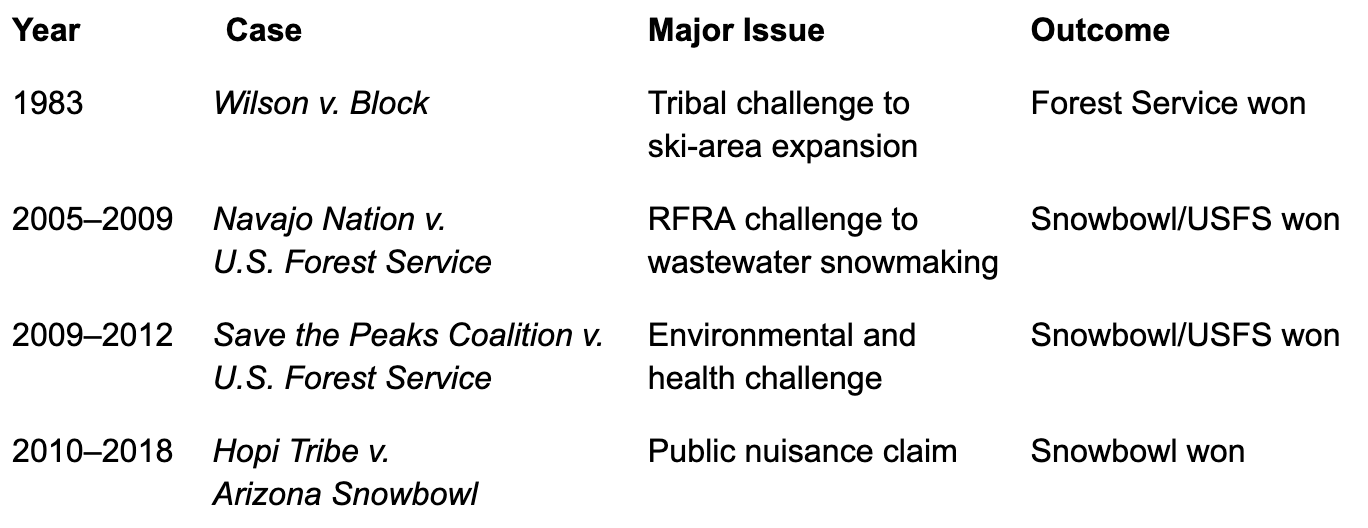
Key Legal Cases Summary
Timeline
Early Development and Federal Authorization
1915 — Informal skiing begins on the Peaks
Ole and Pete Solberg reportedly began recreational skiing on the San Francisco Peaks using handmade skis.
1938 — Forest Service authorizes ski-area construction
The U.S. Forest Service approved construction of a road and ski lodge on federal land in Hart Prairie on the western slope of the Peaks. This marked the beginning of formal ski-area development under federal authorization.
1941 — First major transfer of special-use operations
Control of the ski facilities transferred to private operators Al Grasmoen and Arnal Corporation under the Forest Service special-use framework.
1958–1962 — Lift infrastructure installed
A Poma lift was installed in 1958, followed by a chairlift in 1962, significantly expanding ski operations.
First Major Expansion Era
1969 — Large-scale resort expansion proposed
Snowbowl proposed substantial resort expansion including lodges, restaurants, parking, and expanded ski terrain. Tribal and environmental opposition intensified.
1977–1979 — Forest Service reviews master expansion plan
Snowbowl submitted a formal master development plan seeking:
New chairlifts
Expanded trails
Parking expansion
Road paving
Additional ski terrain
The proposal would expand the permitted ski area to approximately 777 acres.
1979 — Forest Service approves expansion
The Forest Service approved major infrastructure improvements under the special-use permit.
Wilson v. Block Era (First Major Tribal Lawsuits)
1979–1980 — Tribes sue over expansion
The Hopi and Navajo Nations filed lawsuits challenging the Forest Service approval, arguing violations of:
American Indian Religious Freedom Act
National Historic Preservation Act
Endangered Species Act
Wilderness Act
1980 — Forest Service approves road paving
Despite tribal objections, the Forest Service regional supervisor approved paving the access road into Snowbowl.
1983 — Wilson v. Block decided
The D.C. Circuit Court upheld the Forest Service approval in Wilson v. Block, ruling that ski-area expansion did not unlawfully burden Native religious practices under federal law. The U.S. Supreme Court declined review later that year.
This became one of the foundational federal cases involving Native religious claims on federal land.
Snowmaking and Wastewater Expansion Era
1986 — Forest Ski Area Permit Act
Congress enacted the Forest Ski Area Permit Act, formalizing long-term ski-area special-use permits on national forest lands. Snowbowl’s permit became renewable on 40-year terms.
2002 — Snowbowl submits major modernization proposal
Snowbowl proposed:
Artificial snowmaking
Use of reclaimed wastewater
New lifts
Additional trails
Terrain expansion
Lodge and facility upgrades
The stated goals were longer and more reliable ski seasons and expanded recreation capacity.
2004–2005 — Environmental review and FEIS
The Forest Service conducted an Environmental Impact Statement process evaluating snowmaking with reclaimed wastewater from the City of Flagstaff.
2005 — Forest Service approves wastewater snowmaking plan
The Forest Service approved:
Artificial snowmaking
Pipeline infrastructure
Use of treated reclaimed wastewater (“Class A+ reclaimed water”)
New ski lifts
Additional ski terrain and facilities
This became the most controversial decision in Snowbowl history.
2005 — City of Flagstaff wastewater agreement
The City of Flagstaff entered agreements to supply reclaimed wastewater for snowmaking operations at Snowbowl. This triggered major political and legal disputes locally and among tribes.
Navajo Nation / RFRA Litigation
2005 — Tribes and environmental groups file federal lawsuit
Plaintiffs included:
Navajo Nation
Hopi Tribe
Havasupai Tribe
Hualapai Tribe
White Mountain Apache Tribe
Yavapai-Apache Nation
Environmental groups
Claims centered on:
Religious Freedom Restoration Act (RFRA)
NEPA
Health and environmental impacts
Sacred-site desecration
2006 — Federal district court sides with Forest Service
The District Court upheld the Forest Service approval.
March 2007 — Ninth Circuit panel rules for tribe
A three-judge Ninth Circuit panel overturned the approval, holding that wastewater snowmaking substantially burdened Native religious exercise under RFRA.
August 2008 — En banc Ninth Circuit reverses panel
The full Ninth Circuit reversed the earlier decision and allowed Snowbowl’s reclaimed-water snowmaking project to proceed.
January 2009 — U.S. Supreme Court declines review
The Supreme Court denied certiorari, effectively ending the RFRA challenge and allowing construction to proceed.
Secondary Environmental and Health Litigation
September 2009 — Save the Peaks Coalition files new lawsuit
A new lawsuit challenged:
Environmental review adequacy
Human health impacts
Pharmaceutical/endocrine contaminants in reclaimed water
Public safety issues
Plaintiffs sought to stop pipeline construction and snowmaking implementation.
2010 — Federal court dismisses environmental challenge
The U.S. District Court rejected the claims and upheld Forest Service approvals.
2011 — Pipeline construction begins
Construction of reclaimed-water infrastructure and snowmaking systems started. Widespread protests followed, including arrests of activists and Indigenous organizers.
2012 — Ninth Circuit again upholds snowmaking
The Ninth Circuit affirmed dismissal of the environmental challenge in Save the Peaks Coalition v. U.S. Forest Service.
Public Nuisance and State-Court Litigation
2010 — Hopi Tribe files Arizona public nuisance lawsuit
The Hopi Tribe sued:
Arizona Snowbowl
City of Flagstaff
The suit argued reclaimed-water snowmaking constituted a public nuisance interfering with sacred and ceremonial uses of the Peaks.
2018 — Arizona Court of Appeals revives Hopi claims
The appellate court ruled the Hopi Tribe had sufficiently alleged “special injury” to pursue nuisance claims.
November 2018 — Arizona Supreme Court rules for Snowbowl
In Hopi Tribe v. Arizona Snowbowl Resort Limited Partnership, the Arizona Supreme Court ruled the Tribe lacked the type of special injury required for a public nuisance action.
Continuing Expansion and Modern Development
2010s–2020s — Ongoing infrastructure expansion
Snowbowl continued incremental expansion under Forest Service approvals, including:
Additional snowmaking coverage
Lift upgrades
Summer recreation operations
Terrain development
Hospitality expansion
2020s — Continued controversy over sacred-site use
The use of reclaimed wastewater on the Peaks remains controversial among tribes, environmental advocates, and some local residents. Debate continues over:
Federal land management
Indigenous religious rights
Water use in arid climates
Long-term ecological impacts